If you are dealing with that brutal, deep ache in your lower back or a sharp pain that shoots all the way down your leg, you’ve probably heard some absolute horror stories about spine surgery. Most people picture huge cuts, weeks stuck in a hospital bed, and months of painful recovery. It’s terrifying enough to make you choose to just live with the pain and swallow painkillers every day.
But spinal care doesn’t work that way anymore. Over the last few years, a technique called endoscopic spine surgery has completely changed everything. Instead of an old-school, massive operation, doctors can now fix the root cause of your pain through a tiny nick in your skin that is barely wider than a pencil eraser. It is a complete lifesaver for anyone who wants their life back without the heavy downtime.
What actually happens during endoscopic spine surgery?
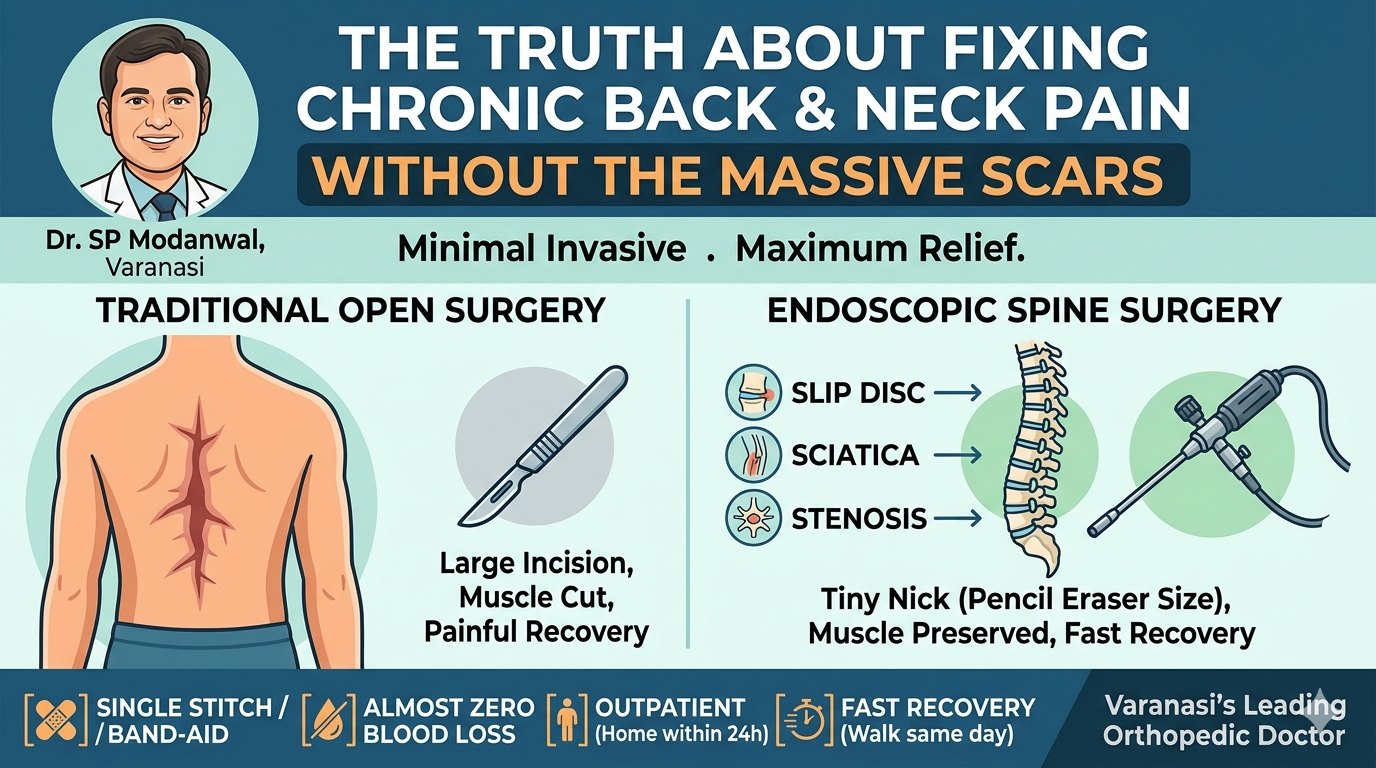
To understand why it’s so much easier on your body, look at how it actually works. In a traditional surgery, a surgeon has to make a long cut down your back and physically pull your muscles away from the bone just to see the problem. That muscle tearing is what causes the intense pain after surgery.
With the endoscopic approach, the muscles aren’t cut or torn at all. The doctor makes a tiny opening and slides in a very slim metal tube. Inside that tube is a microscopic camera and a strong light. This camera beams a highly magnified, crystal-clear image of your spinal nerves directly onto a screen in the operating theater. Using specialized micro-tools passed right through that same tube, the surgeon can gently clear away whatever is pinching your nerve while leaving everything else completely untouched.
What kind of conditions can this fix?
This isn’t just for minor back strains; it treats the major structural issues that cause chronic suffering. It works wonders for a slip disc, which is when the soft gel cushion between your spinal bones bulges out and locks onto a nerve. It’s also the primary solution for sciatica—that agonizing, electric shock feeling that travels through your hip and down your calf. It safely clears out spinal stenosis (where the nerve tunnels naturally narrow over time) and bone spurs that rub against your nerves every time you bend or twist.
The real-world benefits
Because your back muscles are left completely intact, the recovery is night and day compared to traditional open surgery. First of all, the scar is so small it usually needs just a single stitch or a band-aid. Because the tools are so precise, there is almost zero blood loss. Most importantly, you feel significantly less pain when the anesthesia wears off because no muscles were sliced. In fact, it’s usually an outpatient procedure, meaning you can walk out and head home to your own bed within 24 hours.
Who is this surgery meant for?
No good doctor will ever push you into surgery first. You are generally a good candidate for this if you’ve been in severe pain for more than six weeks and absolutely nothing else is working. If you’ve tried bed rest, heavy painkillers, gels, and weeks of targeted physiotherapy and still can’t walk comfortably, surgery becomes the next logical step. Your doctor will look at an MRI scan to make sure the physical problem perfectly matches the exact pain you are feeling before moving forward.
What does the recovery look like?
The old myth that spine surgery leaves you bedridden for six months is totally dead. With this method, you are actually encouraged to stand up, sit, and take a few careful steps around the room a few hours after you wake up. For the first week or two, you’ll stay home, resting and doing very light movements. The mild soreness you feel is easily managed with basic tablets. By week three or four, you’ll start some gentle physiotherapy to build your back strength up safely. By the second month, most people are traveling, walking long distances, and living entirely free of the old, agonizing pain.
The Questions Everyone Asks Before Surgery
Is it actually safe?
It is remarkably safe. Because the surgeon uses an HD camera to look directly at the nerves under extreme magnification, the chance of accidental nerve damage or infection is drastically lower than in old-fashioned, open surgeries.
Will I be put to sleep completely?
Not always. A lot of these procedures are done under local anesthesia with conscious sedation. This means your back is completely numb and you are deeply relaxed, but you stay awake enough to talk to the medical team during the procedure.
Can the slip disc happen again later?
The chances are very low, well under 5%. As long as you maintain a healthy weight, don’t slouch in your chair for hours, and keep your core muscles strong with light exercises, your spine will stay protected for years.
Why people in Varanasi trust Dr. SP Modanwal
When you are dealing with something as sensitive as your spine, you need a surgeon who has handled thousands of complex cases. Dr. S.P. Modanwal brings a massive amount of experience to the table, having trained and served at top-tier institutions like KGMU Lucknow and the BHU Trauma Center.
Practicing out of his clinic near Amra Chauraha and at Highway Hospital, he specializes in these exact modern, muscle-saving endoscopic treatments. By offering this level of advanced care right here in Varanasi, he is the best orthopedic doctor in Varanasi who gives local families a way to get world-class treatment close to home, completely avoiding the emotional and financial nightmare of traveling to distant metro cities.